
Safe Transport of A Critically Ill Patient
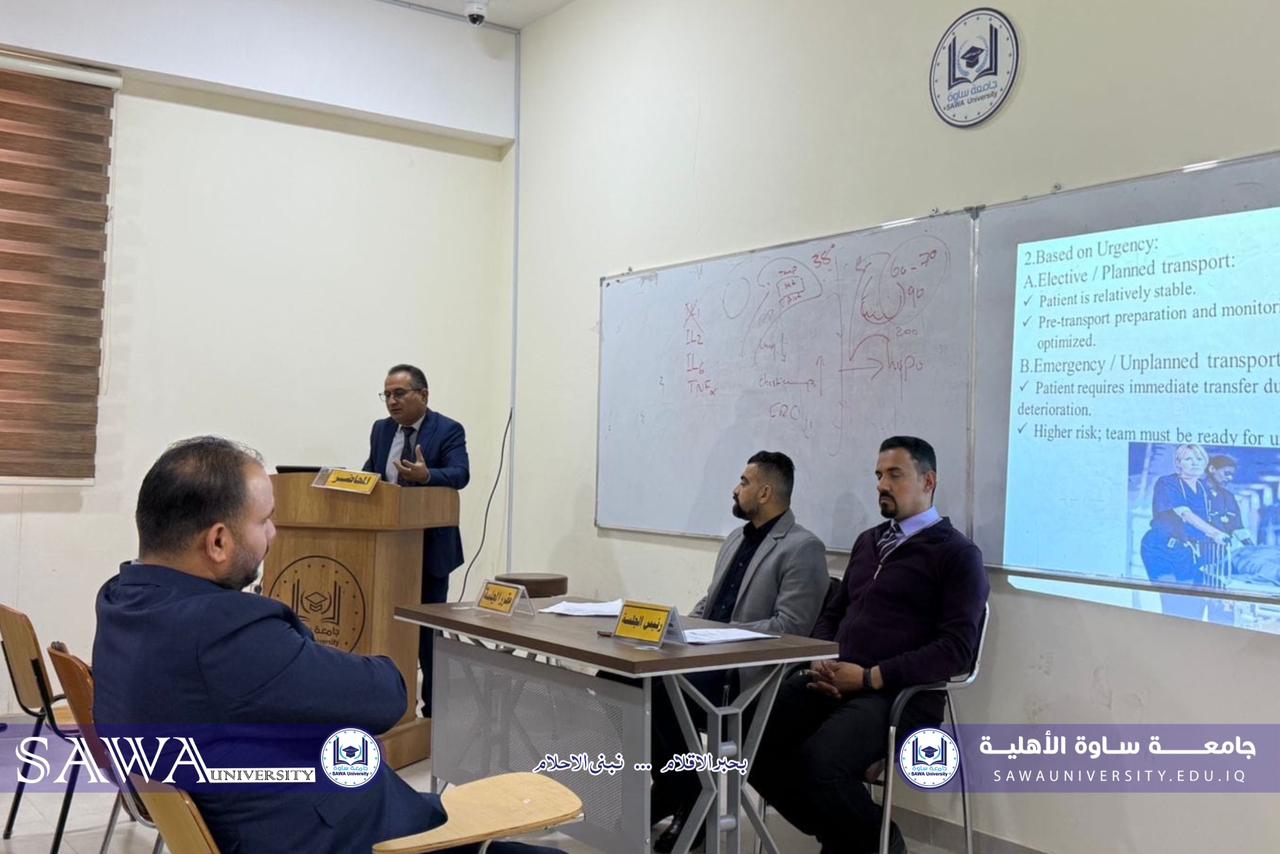
Under the patronage of the Chairman of the Board, Dr. Mudher Abdullah Al-Dhalimi, the President of Sawa University, Prof. Dr. Aqeel Sarhan, and the Dean of the College of Health and Medical Technologies, Asst. Prof. Dr. Hassan Raheem Khadir, the Department of Anesthesia Technologies at the College of Health and Medical Technologies held a scientific workshop entitled "Safe Transport of Critically Ill Patients" at 10:00 a.m. on Saturday, March 7, 2026. The workshop was presented by:
1. Dr. Fadhil Abbas Abid, Lecturer
2. Dr. Asaad Mohan Mohammed, Chairman
3. Dr. Hassanein Ali Naama, Rapporteur
The workshop addressed the safe transport of critically ill patients. It is important to focus on key points that ensure patient safety and minimize complications during transport. The most important points can be summarized as follows:
1. Patient Assessment Before Transport
• Accurate clinical assessment (consciousness, respiration, circulation).
• Ensuring that vital signs are as stable as possible before transport. •
Determine the necessity of transfering and whether the benefits outweigh the risks.
• Assess the need for support equipment such as oxygen or a ventilator.
2. Pre-Transfer Planning
• Identify the destination and ensure its readiness to receive the patient.
• Communicate with the receiving team and provide them with information about the patient's condition.
• Determine the route and mode of transport (within the hospital or between hospitals).
• Prepare the team responsible for the transfer.
3. Patient Preparation
• Secure the airway and ensure the stability of the breathing tube, if present.
• Secure intravenous catheters and medical tubing.
• Secure the patient on the stretcher in a way that prevents falls or excessive movement.
• Administer necessary medications before transfer, if required.
4. Equipment Preparation
• Vital signs monitor.
• Sufficient oxygen supply with a backup.
• Suction device.
• Emergency kit containing essential medications.
• Portable ventilator, if needed.
5. Transfer Team
• A team trained in transporting critical cases.
• Clearly define roles (patient monitoring, equipment handling, communication).
• Ability to handle emergencies during transport.
6. Monitoring During Transport
• Continuous monitoring of vital signs (pulse, blood pressure, oxygen saturation).
• Monitoring of consciousness and respiration.
• Ensuring that equipment continues to function correctly.
7. Managing Complications
• Preparedness for problems such as:
• Hypotension
• Hypoxia
• Airway obstruction
• Cardiac arrest
• A clear protocol for rapid intervention is available.
8. Handover upon arrival
• Hand over the patient to the receiving team with a concise and organized report of the patient's condition.
• Report any changes that occurred during transport.
• Ensure all equipment is properly reconnected.
9. Documentation of the process
• Record the time of transport, the patient's condition, and the equipment used.
• Document any complications that occurred during transport.
.png)